
 EN
EN JA
JA

Where Intelligence Meets Intuition
Key Takeaways
- AI is transforming marketing through automation, predictive analytics, and personalization.
- Human expertise remains essential for creativity, emotional intelligence, and ethical judgment.
- The future of marketing belongs to agencies that combine AI precision with human storytelling.
- Success will come not from choosing sides, but from building stronger human–AI collaboration.
The Shift Has Already Begun
A quiet revolution is reshaping the marketing industry.
Artificial Intelligence is no longer confined to experimentation or reserved for large technology companies. It has steadily become embedded into the daily workings of agencies—powering analytics, influencing creative decisions, streamlining operations, and optimizing campaign performance in real time.
What once required weeks of manual effort can now happen in hours. Campaign insights arrive faster, audience behaviors are predicted earlier, and content production moves at unprecedented speed.
Naturally, this transformation raises an important question: Are AI agents replacing marketers, or redefining what marketing expertise looks like?
The reality lies somewhere in between.
AI is not replacing human marketers, it is changing the nature of their work. The agencies that will thrive are not those resisting AI or blindly depending on it, but those learning how to combine technological intelligence with human creativity.
Because while machines can process information at scale, only humans can turn information into meaning.
The Growing Role of AI in Modern Agencies
AI agents have rapidly become operational partners in modern marketing. Their ability to process vast amounts of data, identify patterns, and automate repetitive workflows has fundamentally changed how agencies operate.
Today, AI can analyze consumer behavior and uncover trends before they become visible to competitors. It can automate media buying decisions, optimize campaigns dynamically, and even create content variations within minutes.
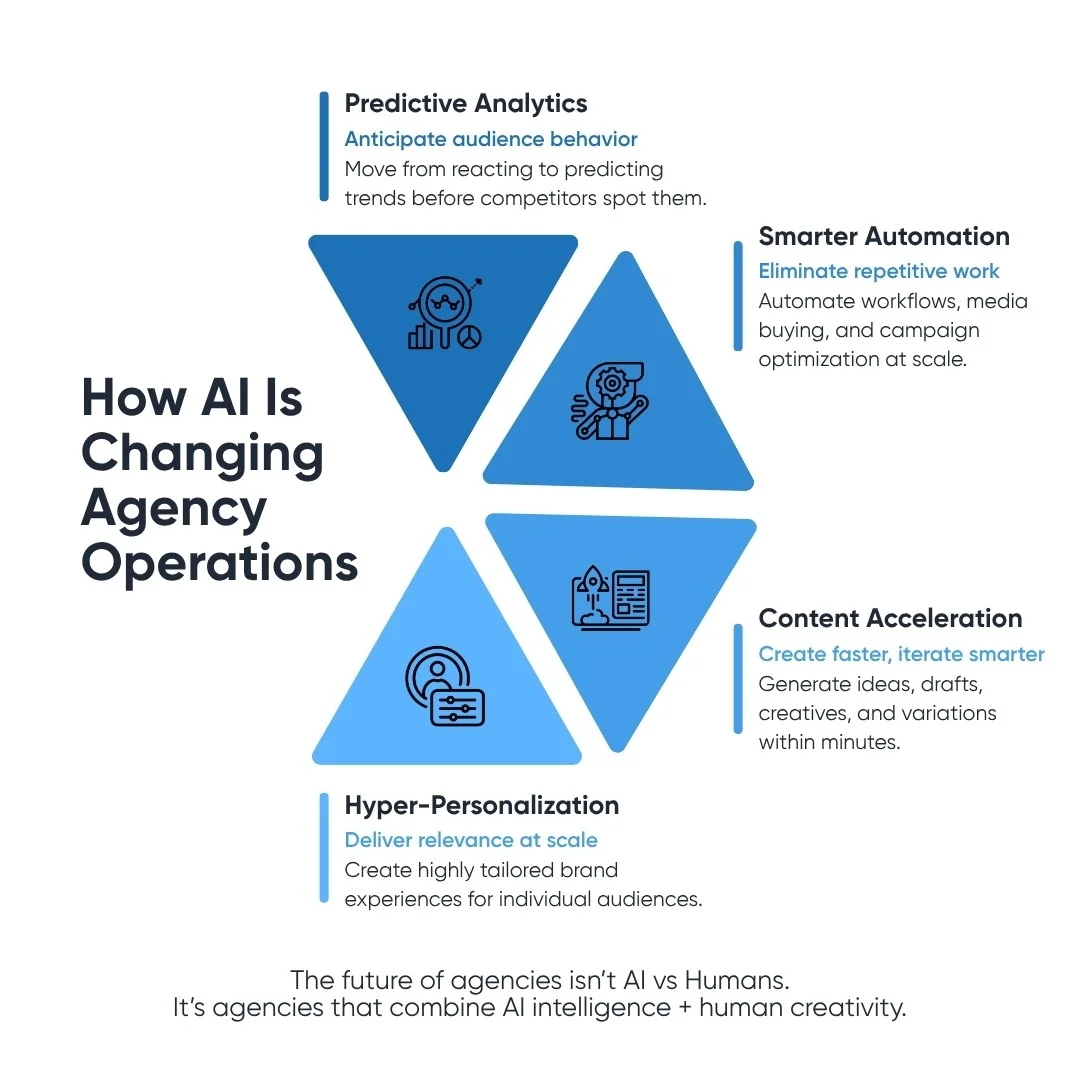
Its biggest contributions include:
- Predictive analytics that help agencies anticipate audience behavior instead of simply reacting to it.
- Automation that improves efficiency by reducing repetitive manual work.
- Content acceleration, enabling marketers to generate ideas, drafts, and variations at scale.
- Hyper-personalization, allowing brands to deliver increasingly relevant experiences to individual consumers.
This shift is significant because AI is no longer just a support tool—it is becoming foundational to how agencies function.
Yet despite its growing influence, AI still has limitations. It can process language, but it cannot genuinely understand emotion. It can recognize patterns, but it cannot fully interpret human complexity.
That distinction matters more than ever.
Why Human Experts Still Matter
Marketing has always been about more than performance metrics.
At its core, marketing is about understanding people, their fears, aspirations, emotions, motivations, and cultural realities. Consumers do not form meaningful relationships with brands because targeting was accurate. They connect because something feels relevant, personal, or emotionally true.
This is where human expertise continues to matter.
Human marketers bring emotional intelligence into the equation. They understand nuance, interpret cultural shifts, and recognize the emotional signals hidden beneath consumer behavior. Data may explain what audiences are doing, but humans are still far better at understanding why.
Creativity also remains deeply human. AI can generate hundreds of ideas based on existing patterns, but the campaigns that truly resonate often emerge from originality, intuition, and unexpected thinking. Great marketing frequently comes from breaking conventions, not repeating them.
Human judgment is equally important in navigating ethical boundaries. As personalization grows more sophisticated, agencies must constantly ask difficult questions around privacy, sensitivity, and authenticity. Knowing what is technically possible is different from knowing what is responsible.
Without human oversight, marketing risks becoming efficient, but emotionally forgettable.
The Rise of the Hybrid Agency Model
The future of agencies will not be defined by humans competing against machines. It will be defined by how effectively both work together.
The smartest agencies are already moving toward a hybrid model, one where AI handles intelligence, automation, and optimization, while humans shape meaning, creativity, and cultural relevance.
Imagine an AI system generating multiple campaign directions overnight based on consumer data and performance insights. Instead of starting from scratch, strategists and creatives begin the next day refining the strongest ideas, injecting emotion, sharpening brand voice, and making the work feel authentically human.
In this model, AI improves speed and precision. Humans improve resonance. Together, they create stronger marketing than either could achieve alone.
New Roles Are Already Emerging
Rather than eliminating jobs, AI is reshaping them.
A new generation of marketing professionals is emerging, people who combine creative thinking with technological fluency. Tomorrow’s agencies will increasingly depend on hybrid talent capable of working alongside intelligent systems.
Some of the emerging roles include:
- Prompt Strategists, who design instructions that guide AI toward stronger and more brand-aligned outputs.
- AI Content Curators, responsible for refining machine-generated content to maintain emotional depth and brand consistency.
- Insight Translators, who convert complex AI-driven analytics into meaningful creative or strategic direction.
- Ethics and Data Advisors, who ensure AI is used responsibly across privacy, inclusivity, and compliance.
These roles signal an important shift: marketers are not becoming less valuable because of AI. Their expertise is simply evolving.
The Challenges Agencies Must Navigate
As exciting as AI may be, it introduces complexities that agencies cannot afford to overlook.
One major concern is algorithmic bias. AI systems learn from historical data, and that data often reflects existing societal biases. Without careful oversight, campaigns risk unintentionally excluding audiences or reinforcing stereotypes.
Another challenge is over-reliance. Efficiency can quickly become sameness. If agencies rely too heavily on machine-generated outputs, brands may begin to lose their distinctive voice and creative originality.
Transparency is becoming equally important. Consumers and clients increasingly want clarity around how data is used and how AI influences communication. Trust will become one of the defining competitive advantages in the years ahead.
Innovation without responsibility rarely lasts.
How Agencies Can Stay Ahead
Adaptability is quickly becoming the most valuable competitive advantage in marketing.
Future-ready agencies will invest heavily in educating teams, not just on how to use AI tools, but on how to think critically about them. Skills such as prompt design, AI ethics, and data storytelling will become increasingly important.
At the same time, agencies must resist the temptation to use AI as a replacement for strategic thinking. Technology works best when it amplifies human capability rather than substitutes for it.
The strongest agencies will also protect authenticity. AI can improve efficiency, but consumers still respond to stories that feel real, emotionally grounded, and culturally relevant.
Success will no longer be measured solely through clicks and impressions. Agencies will increasingly need to measure trust, resonance, and long-term brand connection.
Humanity: Marketing’s Final Differentiator
AI can identify patterns. But it cannot truly understand human experience.
It can predict what someone may click on, but not always why they care. It can imitate language, but not sincerity. It can analyze behavior, but not feel emotion. And in an increasingly automated world, emotional depth becomes more valuable, not less.
Consumers remember brands that feel human. They connect with honesty, vulnerability, humor, and shared experience. That emotional connection remains one of marketing’s greatest competitive advantages.
The Future Is Collaboration, Not Competition
The future of marketing agencies will not be shaped by machines replacing people. It will be shaped by collaboration. AI brings speed, precision, scalability, and intelligence. Humans bring empathy, creativity, context, and judgment.
Together, they create something far more powerful: marketing that is not only optimized for performance, but designed for human connection. The agencies that thrive will not fear AI, nor blindly depend on it. They will learn how to humanize technology. And in doing so, they will define the next era of marketing.
What We Do at Blue Caffeine
At Blue Caffeine, we believe meaningful marketing happens at the intersection of human creativity and machine intelligence.
AI helps us uncover insights, identify opportunities, and move faster. But strategy, storytelling, and emotional relevance still come from human thinking.
Because audiences do not connect with automation. They connect with authenticity. The future of marketing is not man-made or machine-made. It is human-enhanced.
Conclusion: Where Intelligence Meets Intuition
AI and human expertise are not opposing forces. They are complementary strengths.
Tomorrow’s agencies will do more than automate campaigns, they will elevate them. They will combine analytical precision with emotional intelligence, turning data into stories and automation into meaningful experiences.
The future of marketing is already unfolding. And the agencies that succeed will be the ones that understand a simple truth: Technology may power marketing. But humanity gives it meaning.
Frequently Asked Questions
Are AI agents just advanced chatbots?
No. Chatbots typically follow predefined scripts and handle basic interactions. AI agents are significantly more advanced, capable of analyzing data, orchestrating workflows, optimizing campaigns, and adapting strategies autonomously.
Will agencies need fewer marketers?
AI is changing roles rather than replacing them. Agencies are shifting talent toward strategy, creativity, relationship management, and high-value decision-making while automation handles repetitive execution.
How should agencies choose AI tools?
The best approach is integration over experimentation. Agencies should prioritize tools that align with existing workflows, business goals, and data systems instead of adopting disconnected point solutions.
What outcomes can agencies expect?
Agencies using AI effectively often see improvements in campaign speed, customer targeting, operational efficiency, conversion rates, and marketing ROI.

