
 EN
EN JA
JA

Key Takeaways
- Analytics doesn’t show the full buyer journey.
- Private conversations, recommendations, communities, and AI research influence buyers but are hard to track.
- B2B buying journeys involve multiple people and touchpoints.
- Attribution is useful, but it doesn’t tell the whole story.
- Brands need to look beyond clicks and conversions to understand how buyers discover and trust them.
On a random Tuesday morning, a marketing dashboard showed something that looked familiar.
A new lead had come in. The source was Google Organic. The prospect had searched for the company, visited the website, spent a few minutes reading a service page, and filled out a contact form.
On paper, it was a straightforward customer journey.
Google → Website → Form → Lead
The marketing team could measure it. The CRM could record it. The reporting dashboard could assign it to organic search.
But there was one problem.
That wasn’t actually how the prospect found the company. Three weeks earlier, the prospect had seen a LinkedIn post from the company. They didn’t click it. A few days later, a colleague mentioned the company during a team conversation. The prospect made a mental note.
Later, they came across the brand again while reading an industry newsletter. Then they asked someone in their professional network if they had heard of the company. They eventually searched for the brand on Google. They read the website. And then they submitted the form.
Google was the last measurable step. It wasn’t necessarily the first meaningful step. This is the problem marketers are increasingly running into with the dark funnel.
The Part of the Journey Your Dashboard Doesn’t Show
The dark funnel refers to the interactions that influence a buyer but are difficult for traditional marketing analytics to track or connect to a conversion.
Think about where people actually talk about brands today.
- Private WhatsApp groups
- Slack and Microsoft Teams conversations
- LinkedIn DMs and private conversations
- Reddit and industry communities
- Podcasts and newsletters
- Peer recommendations
- Internal meetings
- Reviews and comparison discussions
- AI conversations and recommendations
- Offline conversations
A person might discover your brand in one of these places, form an opinion about you, and only interact with a trackable marketing channel much later. By then, your analytics may record only the final step. And that can create a very different picture of what actually happened.
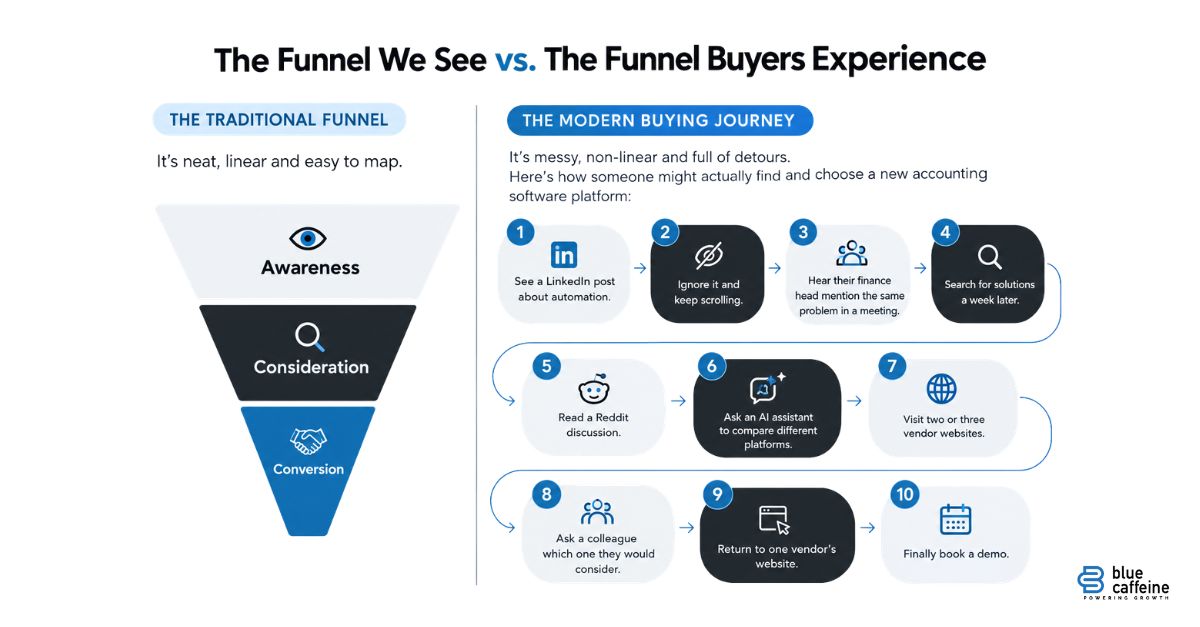
The Funnel We See vs. The Funnel Buyers Experience
The traditional funnel is neat.
Awareness → Consideration → Conversion
The modern buying journey is not.
A prospect can move back and forth between channels, people and information before they ever identify themselves.
Imagine someone looking for a new accounting software platform.
They might:
- See a LinkedIn post about automation.
- Ignore it and keep scrolling.
- Hear their finance head mention the same problem in a meeting.
- Search for solutions a week later.
- Read a Reddit discussion.
- Ask an AI assistant to compare different platforms.
- Visit two or three vendor websites.
- Ask a colleague which one they would consider.
- Return to one vendor’s website.
- Finally book a demo.
Which interaction created the lead?
The answer isn’t necessarily one channel. The journey is cumulative. Each interaction may have played a different role in moving the buyer forward. Yet most analytics systems are much better at recording where someone came from than understanding why they came.
This Matters Even More in B2B
For B2B companies, the gap can be even wider. A consumer might see an advertisement and make a purchase within minutes. A B2B buyer could spend weeks researching a solution before contacting a vendor.
During that time, they may involve multiple people:
- The person experiencing the problem
- The person researching solutions
- The manager evaluating options
- Finance reviewing the numbers
- Leadership approving the purchase
And much of that research happens privately. Someone might send your website to their manager. Someone else might mention your company during a meeting. A colleague might say, “I’ve heard of them.” None of these interactions necessarily creates a marketing event. But they can influence the final decision.
That is why a B2B company can have a prospect who says, “We’ve been hearing about you for a while,” even when the analytics dashboard shows that their first recorded interaction happened yesterday.
Then AI Added Another Door
The dark funnel was already growing. Then AI changed how people discover information. A buyer no longer has to begin their research by visiting Google and clicking through ten blue links.
They can ask an AI assistant:
“What are the main solutions for this problem?”
Then:
“How do these companies compare?”
Then:
“Which ones are suitable for a company like mine?”
The buyer may encounter your brand during that research without ever visiting your website at that point. Eventually, they might search for you directly. When they do, your analytics may simply record:
Organic Search → Website
But the discovery happened somewhere else. This is why the idea of discoverability is becoming as important as traffic.
The question isn’t only:
“How do we get people to our website?”
It is also:
“What happens when people research our category without coming directly to us?”
So, Is Attribution Wrong?
Not necessarily. If Google brought someone to your website and they converted, Google did contribute to that measurable interaction. The problem is what happens when we turn that single interaction into the entire story.
Imagine two reports.
Report A:
Organic Search generated 40 leads this month.
Useful information.
Report B:
Organic Search generated 40 measurable conversions, while branded search increased, direct traffic grew, social engagement increased and sales teams reported more prospects already familiar with the company.
That tells us more. The second view recognises that demand can build across several interactions, some of which cannot be directly attributed. The lesson isn’t to stop using attribution. It is to stop expecting attribution to explain everything.
Look for the Signals Around the Conversion
If the dark funnel cannot always be tracked directly, how do marketers understand it? By looking for signals.
Some useful ones include:
- Branded search: Are more people actively searching for your company?
- Direct traffic: Are more people arriving without an identifiable source?
- Returning visitors: Are people coming back before converting?
- Sales feedback: Are prospects saying they have already heard about you?
- Referral patterns: Are customers mentioning colleagues or partners?
- Community conversations: Is your brand appearing in relevant discussions?
- Content engagement: Are people repeatedly interacting with your ideas even without clicking through?
None of these proves that a specific post or conversation caused a sale. But together, they can help marketers see patterns that a last-click report cannot.
Your Sales Team May Know More Than Your Dashboard
There is another source of dark-funnel information that companies often overlook: sales conversations.
A salesperson might hear:
“My colleague recommended you.”
Or:
“I’ve been following your content.”
Or:
“Your company came up when we were researching this.”
Or simply:
“I’ve heard about you from a few people.”
Those statements matter.
They tell you that the prospect’s journey started before the CRM captured it. One simple question can help uncover some of this: “What first brought us onto your radar?”
Instead of giving prospects a fixed list of channels, an open-ended question can reveal unexpected sources of discovery.
Maybe it was a colleague. Maybe it was a podcast. Maybe it was an industry community. Maybe it was an AI recommendation. Maybe they don’t remember. That information won’t give you perfect attribution. But it can give you a better understanding of how awareness is actually being created.
Stop Creating Content Only for the Click
The dark funnel also changes how we should think about content. A LinkedIn post that doesn’t generate a website visit isn’t automatically unsuccessful. A report that isn’t downloaded isn’t necessarily useless. A useful framework might be shared privately between two colleagues. A case study might be discussed in a meeting. A blog might be bookmarked and read three weeks later. A thought-leadership post might make someone remember your brand when a problem eventually appears.
These are difficult interactions to measure. But they are exactly the kinds of interactions that can influence buying decisions. This means content should be created to do more than generate clicks.
It should be:
- Useful enough to share
- Clear enough to explain internally
- Credible enough to reference
- Specific enough to be remembered
- Discoverable across search and AI
- Relevant enough to start a conversation
The Dashboard Isn’t Lying. It’s Just Telling a Smaller Story.
Go back to that lead from the beginning. The dashboard still says Google Organic. And that isn’t wrong. Google was the channel through which the prospect became measurable. But the prospect’s journey started much earlier. A LinkedIn post created awareness. A colleague reinforced it. An industry newsletter added credibility. A conversation helped validate the company. Search made it easy to find. The website provided the information needed to take action.
There wasn’t one magic touchpoint. There was a series of small moments. Some were measurable. Some weren’t. That is the dark funnel.
It isn’t a mysterious part of marketing happening somewhere in the shadows. It is simply the growing gap between what buyers experience and what our measurement systems can see.
The New Question Marketers Need to Ask
For a long time, marketing teams asked:
“Where did this lead come from?”
That question still matters. But it is only the beginning.
The better questions are:
- Where did the buyer first encounter the problem?
- Where did they research it?
- Who influenced their thinking?
- What made the brand familiar?
- What helped them trust it?
- What finally made them take action?
Not every answer will appear in your analytics. And that’s okay. The goal isn’t perfect attribution. It is a more complete understanding of how demand is created. Because your analytics can tell you where the journey became visible. They cannot always tell you where the journey began. And as more discovery moves into private communities, peer conversations and AI-driven research, that invisible part of the journey is only getting bigger.
The brands that understand the dark funnel won’t stop measuring. They’ll simply stop mistaking the measurable journey for the entire customer journey.
Frequently Asked Questions
What is the dark funnel in marketing?
The dark funnel is the part of the buyer journey that happens outside the marketing interactions a company can easily track. This can include private conversations, peer recommendations, communities, newsletters, podcasts, reviews and AI-assisted research.
Why is the dark funnel becoming bigger?
Buyers now have more ways to research brands and solutions before directly interacting with a company. They can ask colleagues, browse communities, read reviews, consume social content or use AI tools. Many of these interactions are difficult to connect to a later conversion.
Does the dark funnel mean marketing attribution is no longer useful?
No. Attribution remains useful for understanding measurable interactions and campaign performance. The limitation is that attribution cannot always capture every influence that contributed to a buying decision.
How can marketers identify dark-funnel activity?
Marketers can combine analytics with other signals, including branded search, direct traffic, returning visitors, referral information, customer surveys, sales feedback and community discussions. Asking prospects how they first heard about the company can also uncover sources that analytics missed.
How does AI affect the dark funnel?
AI is becoming another place where buyers research companies, products and categories. A buyer can encounter information about a brand through an AI assistant without immediately visiting that brand’s website. This makes discoverability across AI-driven search and recommendation environments increasingly relevant.
Is dark-funnel marketing only relevant to B2B?
No, but it can be particularly significant in B2B because buying journeys are often longer and involve multiple stakeholders. Buyers may discuss vendors with colleagues, research independently and seek recommendations before contacting a company.
What should brands do about the dark funnel?
Brands cannot realistically track every private conversation, nor do they need to. Instead, they should focus on creating useful, credible and discoverable content across the places where their audience researches and discusses problems. They should also combine quantitative analytics with qualitative feedback from customers and sales teams.
What is the biggest lesson from the dark funnel?
Your analytics show you the journey you can measure. They don’t necessarily show you everything that influenced the buyer. Understanding that difference helps marketers make better decisions about content, brand visibility, search, AI discoverability and demand generation.


