
 EN
EN JA
JA

How AI Agents Are Transforming Marketing Agencies in 2026
Marketing agencies are entering a new era, one where campaigns are no longer built only through human effort, but through intelligent collaboration between people and AI.
AI agents are redefining how agencies operate by automating repetitive work, improving decision-making, personalizing customer experiences, and accelerating campaign execution. Instead of spending hours on manual reporting, segmentation, or content iterations, teams can focus on strategy, creativity, and business impact.
The future of marketing isn’t human or machine. It’s human and machine.
Introduction: Marketing Is Becoming Agentic
Imagine a marketing agency where campaign ideas are generated instantly, ad creatives adapt in real time, customer journeys personalize automatically, and performance optimizations happen continuously.
That future is already here.
AI agents are rapidly changing how agencies work. Unlike traditional automation tools or rule-based chatbots, AI agents can analyze large datasets, learn from interactions, generate content, optimize campaigns, and make recommendations with minimal human intervention.
For agencies in 2026, the pressure is clear: deliver faster execution, stronger ROI, and more personalized customer experiences, without increasing operational complexity. AI agents are becoming the operating layer that makes this possible.
The Rise of Agentic AI in Marketing
What makes AI agents different from traditional marketing automation?
Traditional systems operate on predefined rules. AI agents adapt. Using contextual intelligence, predictive analytics, and reinforcement-based learning, these systems continuously test, optimize, and refine marketing activities based on real-time performance and audience behavior.
Instead of executing static workflows, AI agents dynamically improve campaigns while they are running.
Today, mid-market and enterprise agencies increasingly deploy AI agents across functions such as:
- Lead generation and qualification
- Real-time campaign optimization
- Content creation and personalization
- Audience segmentation and targeting
- Attribution modeling and performance analytics
Rather than functioning as isolated tools, AI agents are becoming connected systems that help teams work faster, stay aligned, and make smarter decisions.
Human and Machine: The New Agency Model
One of the biggest misconceptions around AI is that it replaces marketers. In reality, the best-performing agencies use AI to amplify human capabilities, not eliminate them. AI agents remove operational friction so teams can spend more time where human expertise matters most.
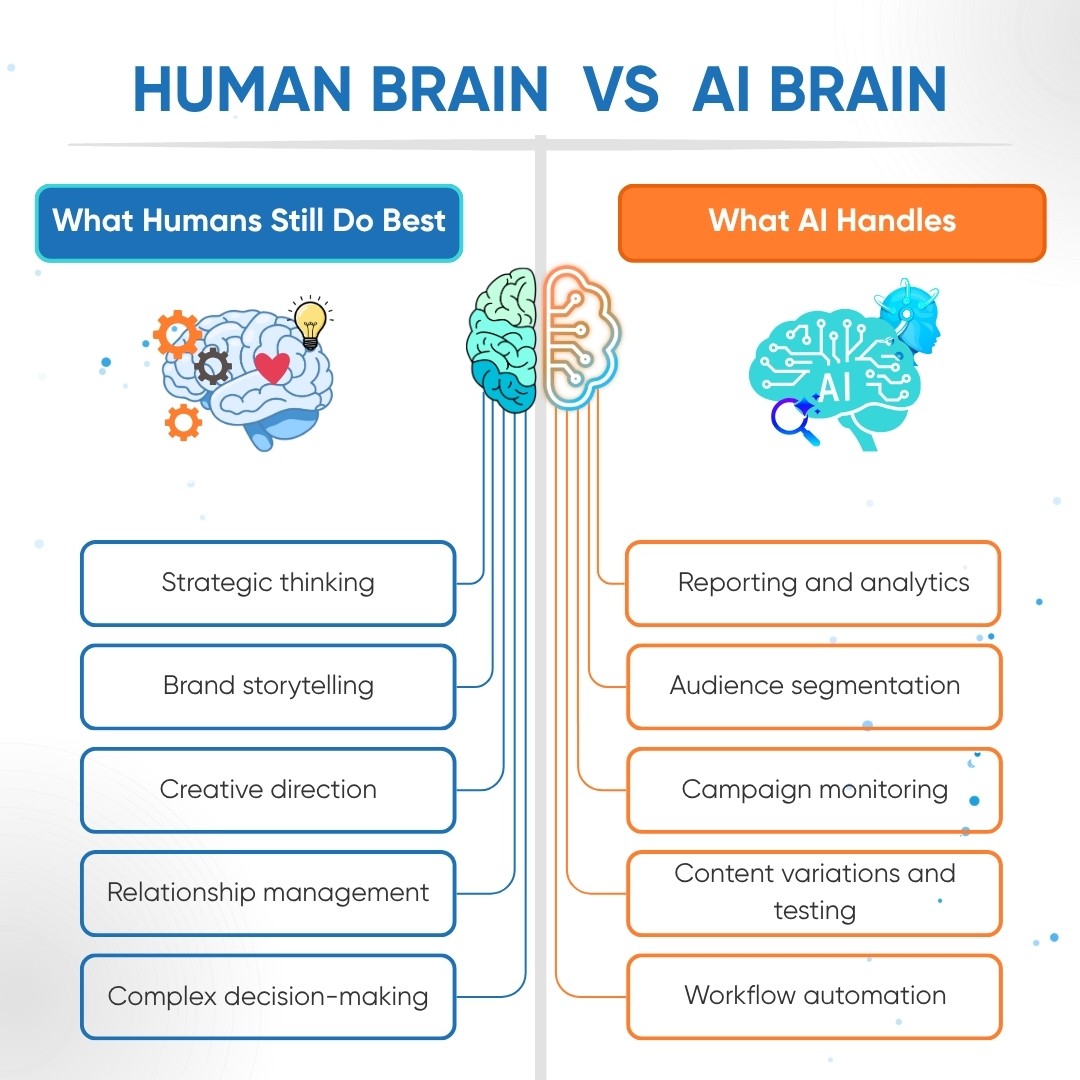
This shift is transforming agency roles. Teams increasingly move from execution-heavy work to strategic oversight, where marketers guide, validate, and refine AI-driven outputs.
The result? Faster execution without sacrificing quality or creativity.
Personalization at Scale Is Finally Possible
Mass marketing is losing relevance. Customers now expect experiences tailored to their interests, intent, and behavior, in real time. AI agents make this level of personalization achievable at scale.
By analyzing behavioral signals, platform engagement, browsing patterns, and historical interactions, AI can dynamically adapt:
- Messaging
- Offers
- Content recommendations
- Ad creatives
- Timing and channel selection
Instead of broad audience assumptions, agencies can now run micro-targeted campaigns that evolve continuously based on performance.
Creative teams are also using AI-generated content variations to test dozens of headlines, formats, and messaging angles simultaneously, helping agencies identify winners faster and scale performance efficiently.
Smarter Tools, Better Integration
The AI ecosystem is expanding rapidly. But success doesn’t come from adopting every new tool. It comes from building an integrated system where AI supports the entire marketing workflow.
Some widely adopted AI-powered platforms include:
- HubSpot for predictive segmentation and content recommendations
- ChatGPT for content ideation, copywriting, and rapid iteration
- Adobe Sensei for visual personalization and creative automation
- Hootsuite for real-time social listening and sentiment tracking
Leading agencies are moving away from “tool chasing” and focusing instead on building intelligent workflows where technology supports strategic outcomes.
Faster Campaign Execution, Better Performance
AI agents function as force multipliers. They reduce manual effort, accelerate experimentation, and enable campaigns to move from idea to execution significantly faster.
Key benefits agencies are experiencing include:
Faster Go-to-Market
Campaigns that once took weeks can now launch in days.
Smarter Budget Allocation
AI optimizes spend dynamically based on real-time performance signals.
Continuous Optimization
Campaigns improve while running instead of waiting for post-campaign analysis.
Better Attribution
AI provides clearer visibility into which channels, creatives, and touchpoints drive conversions.
As a result, agencies spend less time on operational bottlenecks and more time improving outcomes.
Building Trust: Why Human Oversight Still Matters
Despite the speed and efficiency AI offers, human judgment remains essential.
AI can optimize performance, but marketers still play a critical role in:
- Protecting brand voice
- Evaluating strategic direction
- Managing sensitive customer interactions
- Driving creative originality
- Building long-term client relationships
For high-value B2B relationships and complex campaigns, human involvement continues to be indispensable.
The most effective agencies are not replacing people with AI.
They are building systems where AI handles scale and humans provide context, creativity, and empathy.
How Blue Caffeine Is Using AI Agents
Blue Caffeine Digital Labs is already leveraging AI-driven systems to transform digital marketing execution. We combines proprietary frameworks, intelligent automation, advanced analytics, AI and NLP-powered tools to improve every stage of the marketing funnel.
From campaign audits and keyword intelligence to competitive benchmarking and performance optimization, AI enables faster execution, smarter decisions, and more measurable outcomes.
Instead of relying on assumptions, campaigns become continuously optimized, data-driven, and aligned to business objectives.
Conclusion
AI agents are transforming marketing agencies from execution-focused service providers into intelligent growth engines. The shift is not about replacing human marketers. It’s about enabling them to do better work: faster, smarter, and at greater scale.
As AI becomes deeply embedded into agency workflows, competitive advantage will increasingly belong to agencies that combine machine intelligence with human creativity. The future of marketing belongs to those who know how to use both.
Frequently Asked Questions
1. Are AI agents just advanced chatbots?
No. Chatbots typically follow predefined scripts and handle basic interactions. AI agents are significantly more advanced, capable of analyzing data, orchestrating workflows, optimizing campaigns, and adapting strategies autonomously.
2. Will agencies need fewer marketers?
AI is changing roles rather than replacing them. Agencies are shifting talent toward strategy, creativity, relationship management, and high-value decision-making while automation handles repetitive execution.
3. How should agencies choose AI tools?
The best approach is integration over experimentation. Agencies should prioritize tools that align with existing workflows, business goals, and data systems instead of adopting disconnected point solutions.
4. What outcomes can agencies expect?
Agencies using AI effectively often see improvements in campaign speed, customer targeting, operational efficiency, conversion rates, and marketing ROI.