
 EN
EN JA
JA

RAG vs Traditional Generative AI: Why Retrieval-Augmented Models Are the Future
The AI Shift Businesses Can’t Ignore
Artificial Intelligence has quickly moved from experimentation to everyday business use. From generating content to automating support, traditional generative AI has proven its value.
But as businesses begin to rely on AI for more critical tasks, a new question is emerging:
Can you trust the answers AI gives you?
Because while generative AI is powerful, it often lacks one crucial element, reliability.
This is where Retrieval-Augmented Generation (RAG) is changing the game.
The Rise of Traditional Generative AI
Traditional generative AI systems are designed to produce human-like responses based on patterns learned from large datasets.
Today, AI is no longer limited to specific use cases or teams, it is being adopted across entire organizations.
Businesses are using it across:
- Marketing teams for content creation and campaign ideation
- Customer support for faster query resolution
- Sales teams for outreach, proposals, and follow-ups
- Operations for documentation and process automation
- HR and internal teams for communication, onboarding, and knowledge sharing
- Creative and product teams for image generation, design exploration, and rapid development support
From startups to large enterprises, AI is becoming a default layer across functions, not just a standalone tool. But they come with a fundamental limitation: they generate responses based on what they’ve learned, not on what is actually true for your business.
The Problem: When AI Doesn’t Know Your Business
For businesses, context is everything.
Your operations depend on:
- Internal documents
- Policies and workflows
- Customer-specific information
- Real-time updates
Traditional AI systems don’t have access to this.
So when asked business-specific questions, they:
- Make assumptions
- Fill gaps with probabilities
- Deliver answers that sound correct, but may not be
This creates risks, especially in areas like:
- Customer communication
- Compliance
- Decision-making
Because in business, accuracy is not optional.
What is Retrieval-Augmented Generation (RAG)?
Retrieval-Augmented Generation (RAG) introduces a simple but powerful improvement.
Instead of generating answers immediately, it first retrieves relevant information from your data, and then generates a response based on that.
In simple terms:
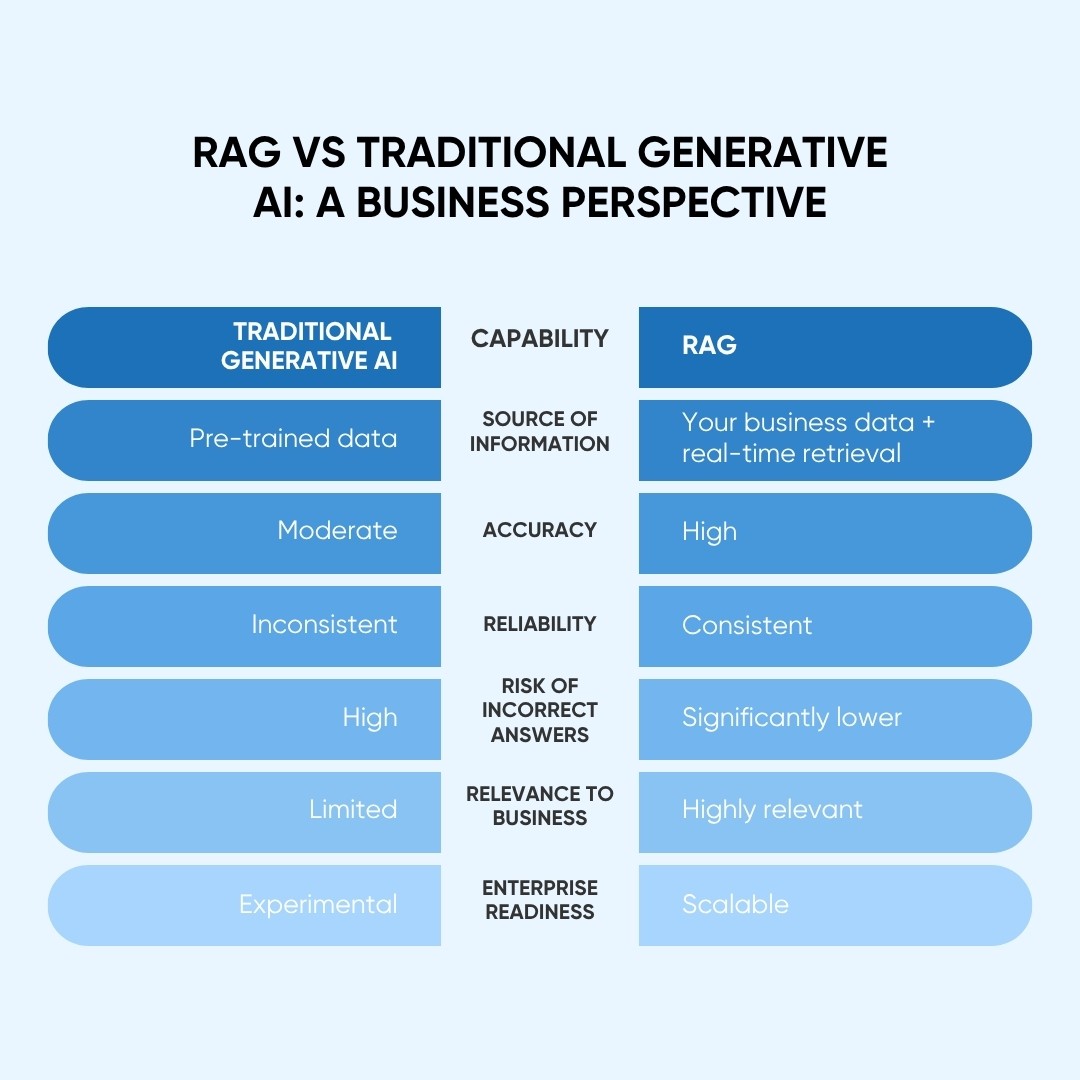
- Traditional AI – Answers from memory
- RAG – Looks up the answer before responding
This ensures that responses are:
- Context-aware
- Data-backed
- Relevant to your business
RAG vs Traditional Generative AI: A Business Perspective
Why Traditional Generative AI Falls Short
- Lack of business context leads to generic outputs
- No source verification makes responses hard to trust
- Outdated knowledge limits access to the latest updates
- Inconsistent outputs result in different answers for the same question
This is why many AI initiatives struggle to move beyond pilot stages.
Why RAG is the Future of Business AI
1. Grounded Responses
Answers are based on actual documents, not assumptions.
2. Real-Time Knowledge Access
No need to retrain models every time information changes.
3. Reduced Risk
Lower chances of incorrect or misleading outputs.
4. Better Decision Support
Leaders and teams get insights they can rely on.
5. Scalable Across Teams
From customer support to operations, everyone accesses the same knowledge layer.
Real-World Business Applications
RAG is already being applied across industries in practical ways:
- Enterprise knowledge assistants
Helping teams find accurate information instantly
- Customer support systems
Delivering consistent and policy-aligned responses
- Sales and pre-sales enablement
Providing quick access to relevant materials
- Document and asset discovery
Reducing time spent searching for information
- Compliance and audit workflows
Ensuring responses are traceable and verifiable
A Growing Need for Distributed Teams
As companies expand across regions and build distributed teams, maintaining consistent knowledge becomes a challenge.
Different teams may:
- Work with outdated information
- Rely on different sources
- Deliver inconsistent outputs
Businesses building offshore teams in India, for example, often face challenges around:
- Knowledge transfer
- Onboarding speed
- Standardization
RAG helps address this by creating a central, reliable source of truth that all teams can access, regardless of location.
In precision-focused markets like Japan, this level of accuracy and consistency is even more critical.
The Future: From AI That Impresses to AI That Delivers
The first wave of AI was about showcasing what machines can do.
The next wave is about ensuring what they do is:
- Accurate
- Reliable
- Business-ready
This is exactly where RAG fits in.
- Guessing to Knowing
- Generic to Contextual
- Impressive to Dependable
Conclusion
AI is no longer a novelty, it’s becoming a core part of how businesses operate. But as reliance on AI grows, so does the need for trust and accuracy.
Retrieval-Augmented Generation is not just the future of AI, it’s the foundation for making AI truly useful in business.

Frequently Asked Questions
1. What is RAG in AI?
RAG stands for Retrieval-Augmented Generation. It’s a type of AI that finds relevant information from a database and then uses it to generate accurate answers, making AI smarter and more reliable.
2. How is RAG different from regular AI models?
Regular AI models only use what they learned during training. RAG looks up extra information while generating answers, so it can provide more accurate and up-to-date responses.
3. Where is RAG used?
- Chatbots and virtual assistants
- Enterprise search tools
- Research and knowledge platforms
- Fact-checking AI systems
4. How does RAG work?
RAG has two main parts:
- Retriever: Finds relevant documents or data.
- Generator: Creates answers using the retrieved information.
5. What are the benefits of using RAG?
- More accurate AI responses
- Context-aware and relevant answers
- Reduces errors or “hallucinations” in AI outputs
6. Are there any challenges with RAG?
- Needs a good quality database to work well
- Can require more computing power than normal AI
- Outputs are only as reliable as the retrieved information