
 EN
EN JA
JA
Generative Engine Optimization (GEO): The Next Frontier for Content in 2026
Generative Engine Optimization (GEO) is rapidly becoming essential for brands that want to remain visible in AI-powered search and answer engines.
Unlike traditional SEO, GEO requires a shift toward structured, authoritative, and semantically clear content designed specifically for generative AI systems. Brands that adopt GEO early will gain a long-term advantage as consumer search behaviour continues to move toward AI-generated summaries and conversational answers.
From Ranking Pages to Powering Answers
Imagine you’ve spent years perfecting your website’s SEO. Your blog posts rank high for coveted keywords, backlinks are rolling in, and your pages gleam in Google search results. But there’s another force arriving, not just a new wave, but a digital tsunami: generative AI engines.
In 2026, users are searching less by typing static queries into a search box. Instead, they’re voicing complex, natural-language questions and expecting AI tools like ChatGPT, Google’s Gemini, or Perplexity to assemble instant, comprehensive answers.
Suddenly, ranking alone isn’t enough. Your content must be surfaced, summarized, and cited by these AI models at the precise moment consumers ask. Welcome to the age of Generative Engine Optimization (GEO) where preparing your digital assets for the AI era isn’t optional; it’s a necessity.
What exactly is GEO?
Generative Engine Optimization (GEO) is the art and science of making your content discoverable and quotable by the world’s most advanced AI systems.
Where search engine optimization (SEO) focused on keywords, title tags, and metadata for Google, GEO optimizes for how AI engines comprehend, trust, and regurgitate content in their answers.
GEO means your content must:
- Be structured and marked up so that AI can easily “read” it.
- Establish clear topical authority and entity relationships.
- Prioritize factuality, clarity, and a deep explanation, since AI engines synthesize not just link your information.
- Be regularly updated to align with AI model training cycles and evolving knowledge graphs.
On a practical level, this involves creating schema-rich HTML, using clear headings and summaries, linking your data to authoritative sources around the web, and documenting your expertise because generative engines reward trustworthy attributions.
GEO vs. Traditional SEO: What’s Different?
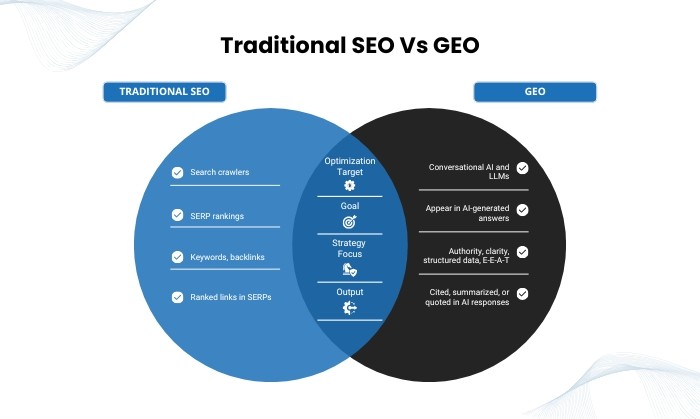
GEO does not eliminate the need for SEO, but it’s a crucial layer that ensures your brand isn’t lost as AI-driven interfaces become the dominant way people get answers.
Why GEO Matters NOW
The stats are impossible to ignore:
- Platforms like ChatGPT have over 400 million weekly users, and AI “Overviews” appear in billions of Google searches a month.
- Up to 25% of organic traffic may be lost as AI systems answer user queries directly, bypassing traditional web clicks.
- Nearly 80% of users now trust AI-generated summaries for complex, multi-step queries, a number that’s still rising.
If your content isn’t designed for generative engines, it risks becoming invisible not just on Google, but everywhere AI search happens. For marketers and brands, not preparing for GEO means not showing up when the next generation of consumers is ready to buy, visit, or learn.
How to Succeed with GEO: Practical Steps
- Structure for Machines and Humans
- Use semantic HTML, schema.org markup, and clear hierarchies.
- Structure FAQs, tables, and summaries to be easily extracted and cited.
- Establish Topical Authority
- Thoroughly cover subjects.
- Link out to reputable sources.
- Use consistent entity references (people, places, brands) so AI can “connect the dots.”
- Update Content Frequently
- Align updates with major LLM launches and retraining cycles.
- Address emerging questions and fill topical gaps rapidly.
- Optimize Content Quality
- GEO values E-E-A-T: Experience, Expertise, Authoritativeness, Trustworthiness.
- Present clear, comprehensive answers, not just keywords.
- Monitor AI Citations
- Track how often and in what context your brand is referenced in AI outputs.
- Use these insights to refine and upgrade your core content accordingly.
The New Metrics: Beyond Traffic
As AI-generated answers slash click-through rates, GEO introduces novel ways to measure success:
- Citation frequency in AI/LLM outputs.
- Visibility in AI Overviews and zero-click answer boxes.
- Brand mentions quality (positive, negative, authoritative).
- Share of voice within AI-generated summaries, not just SERP positions.
Leading brands will track these metrics to understand and defend their digital presence in the age of generative search.
FAQs
- What’s the difference between GEO and SEO?
GEO focuses on visibility in AI-generated answers, not just organic rankings, and requires optimizing for clarity, semantic structure, and trust, beyond keywords and backlinks. - Do brands need to abandon SEO for GEO?
No SEO and GEO are complementary. Brands must invest in both to succeed in human and AI search environments. - How quickly is GEO adoption growing?
Extremely fast driven by the surge in AI assistant use. Early adopters will have the edge as traditional SERPs shrink.
A Thought from Blue Caffeine
In every revolution, there’s a moment when yesterday’s best practices turn into tomorrow’s baseline. Generative Engine Optimization marks that moment for marketers and storytellers in 2026.
At Blue Caffeine, we believe GEO isn’t just a technical shift, it’s a creative invitation: to write, structure, and design content for a world where conversations are powered by AI, and discovery happens in a blink.
With every lesson learned from working with AI-driven campaigns, we see one truth shine: The heart of your brand the expertise, empathy, and originality must be as discoverable to algorithms as it is to people. That’s why our mission is simple: Help brands shape not just what AI finds, but what it chooses to say.
The future belongs to organizations that build bridges across this new digital divide, blending deep human insight with technology, ensuring every answer, summary, and story points right back to you. Let’s not just show up in search, let’s own the narrative in the age of generative engines.
Conclusion
The next frontier for content is clear: brands must optimize for people and machines. GEO requires a mindset shift from chasing keywords to delivering clarity, authority, and technical accessibility for AI. The brands that evolve their digital strategy for generative engines will build relationships with the next generation of consumers, wherever and however they search.