
 EN
 JA


Key Takeaways
- AI acts as a smart assistant for front-end developers, automating routine work rather than replacing human roles.
- Modern AI tools convert design mockups and wireframes directly into functional code, drastically speeding up early prototyping.
- Developers use AI pair programmers to generate boilerplate code and finish coding tasks up to 55% faster.
- AI accelerates debugging by spotting real-time layout bugs, syntax errors, and broken dependencies with instant fix suggestions.
- The developer’s daily role is shifting from typing basic syntax to curating code, optimizing performance, and building great user experiences.
For years, sci-fi headlines have warned that artificial intelligence would replace software developers. But step onto a modern web development team today, and you will see a very different reality.
AI is not replacing front-end developers, it is quietly transforming how they work every single day. Instead of replacing human judgment, AI tools act like hyper-efficient assistants, taking over repetitive boilerplate tasks and freeing developers to focus on creative problem-solving and user experience.
Here is a look at how AI is reshaping the front-end development workflow across coding, debugging, and prototyping.
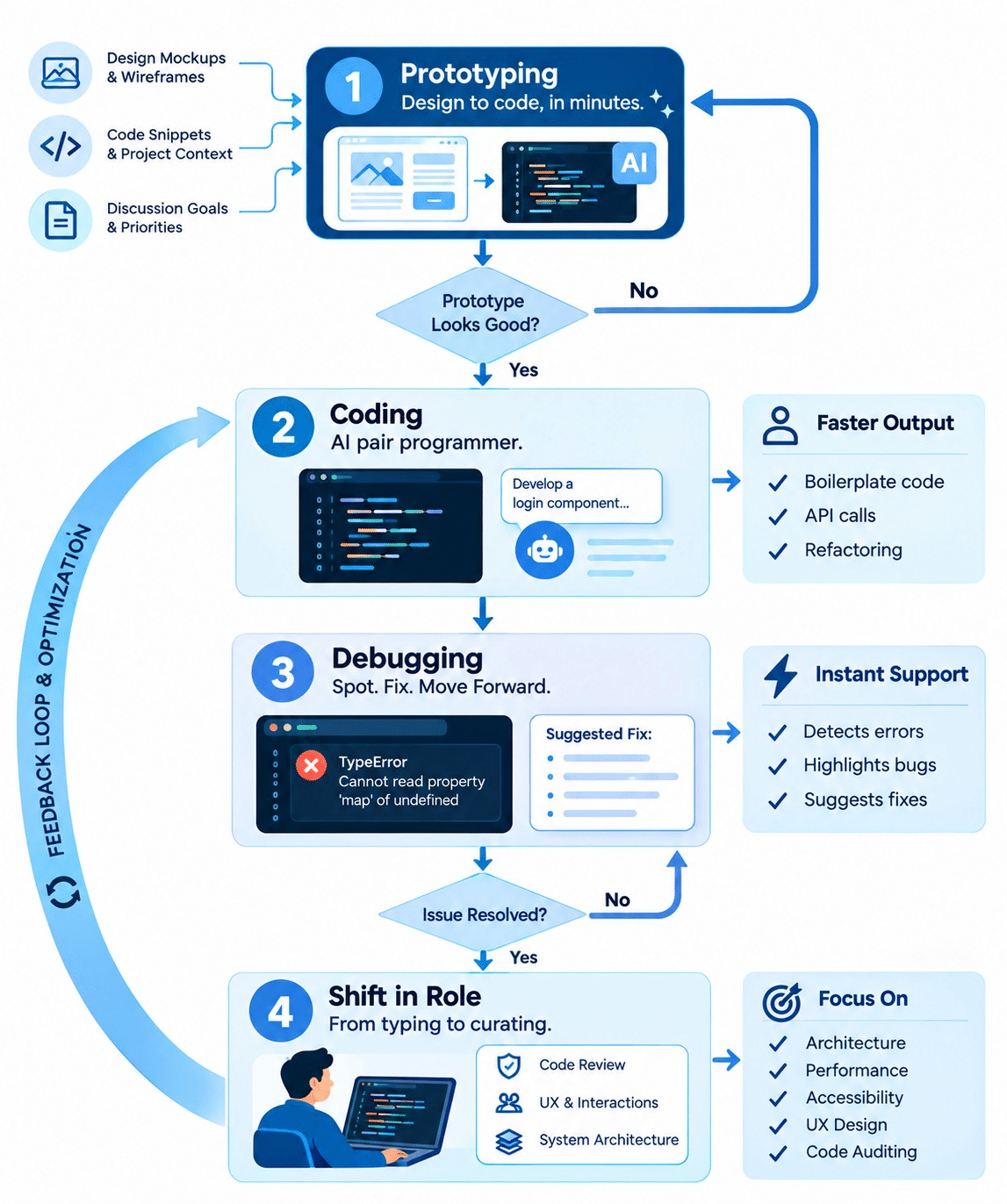
1. Prototyping: From Design to Code in Minutes
Historically, bringing a design concept to life meant a tedious handoff process. Designers created wireframes in Figma or Adobe XD, and front end developers built those layouts from scratch using HTML, CSS, and JavaScript.
Today, AI-powered design-to-code tools allow developers to transform static visual mockups into functional UI components almost instantaneously. Developers can feed a wireframe or UI screenshot into an AI model and receive clean, responsive CSS grid layouts or React components within seconds. This speeds up early prototyping and helps teams iterate on product ideas much faster.
2. Coding: The Rise of AI Pair Programmers
Writing repetitive code like standard forms, simple API calls, and layout templates takes up a significant chunk of a developer’s workday. AI assistants like GitHub Copilot and ChatGPT have fundamentally changed this dynamic by generating routine code snippets directly within the developer’s text editor.
Rather than searching through forums for syntax, developers can write simple plain-English comments, and AI will generate the corresponding code block. Research by GitHub shows that developers using AI coding tools complete tasks up to 55% faster, primarily because these tools remove the friction of writing boilerplate code.
3. Debugging: Faster Error Detection and Fixes
Every developer knows the frustration of spending hours hunting down a single missing syntax bracket or broken CSS layout bug. Debugging has traditionally been one of the most time-consuming parts of front-end work.
AI tools accelerate this process significantly. Modern code editors equipped with AI can spot logical errors, identify memory leaks, and highlight broken dependencies in real time. Developers can copy a confusing error message into an AI chat assistant, ask “Why is this component failing to render?”, and get an instant explanation along with a suggested fix. This turns debugging into a quick learning moment rather than a productivity roadblock.
4. Shift in the Developer Role: From Writing to Curating
Because AI handles routine tasks, the everyday role of the front-end developer is shifting up the value chain.
Developers are spending less time typing basic code and more time acting as architects and editors. Their core responsibilities are moving toward:
- Code Review:Reviewing AI-generated code for security vulnerabilities, accessibility (a11y), and performance optimization.
- User Experience (UX):Ensuring animations, interactions, and design systems feel smooth and intuitive for human users.
- System Architecture:Deciding how front-end components connect with back-end APIs and state management systems.
Industry analyst firm Gartner notes that AI is reshaping software engineering by moving developers toward higher-level design, security, and strategic tasks rather than eliminating engineering jobs altogether.
AI is not taking over front end development; it is elevating it. By taking over the tedious overhead of coding, debugging, and prototyping, AI allows front end developers to spend less time fighting with syntax and more time building delightful, user centric web experiences.
Frequently Asked Questions
Will AI replace front-end developers in the near future?
No. AI is replacing repetitive coding tasks, not developers. Human judgment is still essential for user experience design, complex web architecture, security reviews, and strategic decision-making.
How does AI speed up the design-to-code prototyping process?
AI-powered tools can scan static visual mockups, wireframes, or screenshots and automatically convert them into functional HTML, CSS, or React components within seconds.
Does using AI code generation tools compromise code quality?
AI-generated code can sometimes contain errors, outdated practices, or security risks. That is why developers act as reviewers, auditing and refining AI suggestions before pushing code to production.
How does AI assist with debugging front-end application errors?
Instead of spending hours searching forums, developers can feed error logs or broken code snippets into AI tools to receive instant context, error explanations, and recommended fixes.
What skills should front-end developers focus on as AI tools evolve?
Developers should focus on high-level skills like system architecture, web accessibility (a11y), performance optimization, UX design, and code auditing.


